The red score arrives before the evidence
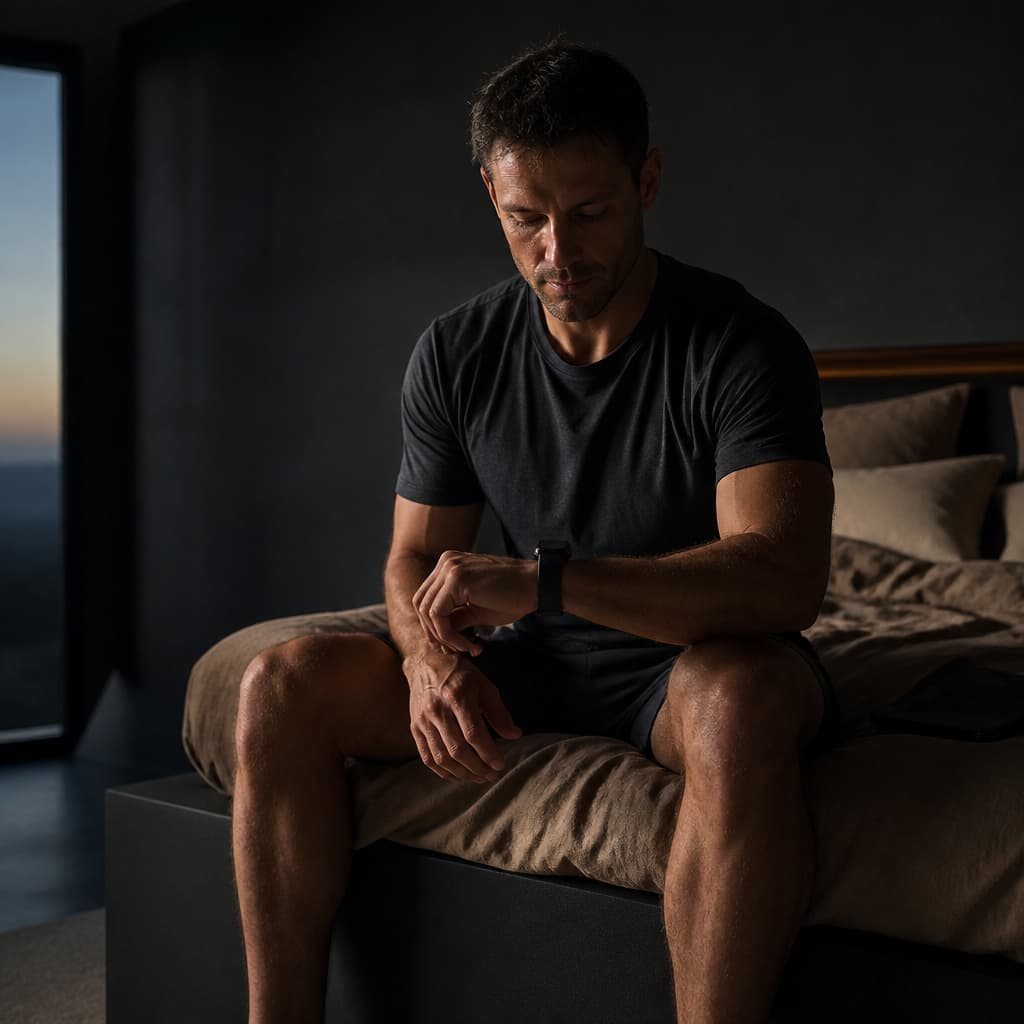
You felt ready until your wearable told you not to. At 6:40, you wake clear-headed and plan a demanding lower-body session. Then the wrist display turns red: estimated sleep was short and resting pulse sat above its recent baseline. That conflicts with normal energy, low soreness and no unusual symptoms. The mistake would be to let either side win immediately. You hold the decision through the warm-up. Familiar loads move normally, technique is stable, perceived effort is unsurprising and the wider week contains no obvious overload. The session is maintained, with a reassessment after the first main set. If movement quality deteriorates, symptoms emerge or effort jumps unexpectedly, reduce, substitute or stop and seek appropriate advice. This is not a victory of instinct over technology. It is a better decision because multiple signals—not one score—were allowed to matter.
Measurement is not meaning
Consumer wearables do not directly observe readiness. Sensors capture inputs such as movement and optical pulse signals; algorithms then estimate sleep, recovery or related states. The measurement may be real while the meaning remains unsettled. A 2024 living umbrella review covering 24 systematic reviews and 249 validation studies found substantial variation across devices and biometric outcomes. A 2025 sleep review and meta-analysis likewise reported that no tested device was consistently superior to polysomnography across all sleep measures, with heterogeneity and study limitations restricting stand-alone interpretation.
For sleep, broad duration and efficiency estimates are generally more usable than precise stage-by-stage claims. Wake detection can be a particular weakness. In one laboratory study involving people with insomnia, trackers detected sleep readily but were much less specific when identifying wake. That finding does not describe every person or device, but it exposes the category error: an estimate can disagree with experience because the estimate is noisy, because experience is incomplete, or because both are capturing different parts of the night. Measurement describes an input. Meaning is what that input should change.
Wearables are better at estimating patterns than pronouncing truth.

The expectation loop
A score does not merely report an experience. It can become part of it. Research on automation bias shows that people may favour automated output and neglect conflicting information, particularly when the system appears precise and the underlying task is complex. Applying that work to readiness scores is a reasonable interpretation, not direct proof about every wearable user.
Sleep research offers a sharper warning. The term orthosomnia was introduced to describe an unhealthy pursuit of perfect wearable sleep data. It is useful here as a caution, not a label for someone who checks an app. Experimental nocebo work also shows that negative expectations can alter pain and other bodily perceptions. A red score may therefore redirect attention towards heaviness, soreness or poor concentration that might otherwise have passed unnoticed.
Interoception—the sensing and interpretation of internal bodily signals—is not an infallible truth channel either. Expectations, attention and prior experience shape it. The point is not that the device creates every bad day, or that subjective feeling always wins. It is that the score and the feeling can influence each other. Once that loop starts, observation is no longer passive.
Use disagreement as a protocol
When device and lived experience disagree, do not ask which one deserves permanent authority. Ask what would have to be true for each signal to be useful. External measurement deserves more weight when a pattern repeats under comparable conditions and aligns with recent load, restricted sleep opportunity, emerging symptoms or a measurable decline in performance. Lived state and direct task performance deserve more weight when the device output is isolated, the metric has known limitations and warm-up behaviour remains coherent.
This is the practical logic of [readiness-based training]: inspect the data source, compare timescales, test the claim and make a proportionate change. The recommendation should explain what changed, why it matters, which signals carried weight, which signal was discounted and why an alternative was rejected. Sometimes disagreement reveals sensor noise. Sometimes it reveals fatigue that motivation was masking. Sometimes there is not enough information to know. In that case, preserve optionality: avoid aggressive progression, set a reassessment point and let the next useful observation update the decision.
Signals
- Device trend
- Lived state
- Recent load
- Warm-up
Uncertainty
- Data quality
- Signal agreement
- Missing context
Safety
- Symptoms
- Technique
- Override conditions
Decision
- Maintain
- Reduce
- Substitute
- Delay
Explanation
- What changed
- What mattered
- What was discounted
- When to reassess
Disagreement is not a system failure. It is a reason to inspect the inputs.
Decision confidence
High confidence applies when a repeated device trend agrees with recent load, sleep opportunity, symptoms and observed performance. Medium confidence applies when useful signals conflict: for example, a low score beside a normal warm-up and stable technique. Low confidence applies when the reading is isolated, the device fit or data quality is doubtful, information is missing, or the estimate concerns a metric wearables handle poorly. Weight repeated trends, direct symptoms and task-specific performance; discount the single proprietary score. Reject the alternative of automatically cancelling because an app turns red. Maintaining the original plan is justified when warm-up performance, technique, symptoms and the wider week remain normal despite one questionable reading. In Flex Force X, the [system] is designed to connect information, evaluate confidence, apply safety rules, adapt recommendations and explain reasoning. When evidence stays mixed, the safer response is conservative: hold progression, shorten optional work, reassess later or seek appropriate professional input if concerning symptoms persist.
Decision cost runs both ways
Pushing training because of an optimistic score can add fatigue or injury risk. A green display cannot verify sound technique, erase symptoms or make an aggressive progression appropriate. When those stronger signals disagree, safety controls and human judgement should override the performance target.
Reducing training because of a noisy score can create a weaker training stimulus, slower progress and missed opportunity. Repeated unnecessary reductions may also teach the user that every anomaly requires retreat. This is why [adaptive workout plans] should make proportionate changes rather than maximise either work or caution. Maintain when the evidence for change is weak. Reduce or shorten when several signals align. Substitute or delay when the likely downside of continuing is materially greater. The objective is not more training or less training. It is the most appropriate decision available from incomplete information.
A decision tool earns its place by changing the right decisions—and leaving the right plans alone.
A seven-day self-trust experiment—and the counterargument
For seven days, interrupt the expectation loop. Before opening the app, record a brief description of energy, soreness, mood, sleep recollection and the planned session. Then reveal the score and note whether your perception or plan changes. During training, record warm-up quality, technique, unusual symptoms, actual work completed and the reason for any adaptation. Afterwards, capture whether the decision still appears proportionate. This is not a contest to prove that the body or the device is always right. It is an audit of how each input affects judgement.
At the end of the week, look for repeated agreement, false alarms and misses. Did the device notice accumulated strain that memory overlooked? Did one poor score derail an otherwise normal day? Did enthusiasm hide a real performance decline? Wearables have a strong counterargument in their favour: structured external records can expose trends, reduce recall error and encourage useful behaviour. The direct evidence that they erode self-trust in healthy recreational athletes is much weaker than the evidence showing variable measurement accuracy and the broader effects of expectations and automation.
The responsible position is therefore conditional. Use external data when it adds information; discount it when its quality is weak; never assume subjective experience is automatically correct; and let safety override both. Consumer sleep technology is not a substitute for clinical evaluation. If concerning symptoms persist or a health question is involved, seek appropriate professional advice and refer to our [medical disclaimer]. A wearable should extend your judgement, not train you to surrender it.
REFERENCES
Sources
- Consumer wearable accuracy: a living umbrella review of systematic reviews.View source
- Systematic review and meta-analysis of wearable sleep trackers compared with polysomnography. Sleep Medicine.View source
- Consumer Sleep Technology: An American Academy of Sleep Medicine Position Statement. American Academy of Sleep Medicine.View source
- Validation study of consumer sleep trackers against polysomnography in insomnia disorder.View source
- Automation bias: a systematic review of frequency, effect mediators, and mitigators.View source
- Orthosomnia: Are Some Patients Taking the Quantified Self Too Far?.View source
- Experimental research on negative expectations and nocebo responses.View source
- Research perspective on interoception and the interpretation of bodily signals.View source
HUMAN REVIEW
Reviewed by
- Peter WestonDesignated Legal ReviewerLegalDesignated by Flex Force X