

Why HRV is useful — and why your own baseline matters most
Heart rate variability, or HRV, is a way of describing the tiny beat-to-beat changes in time between heartbeats. In sports settings, it is often used as a rough window into how much stress the autonomic nervous system is carrying and how recovered an athlete may be after training. For recreational athletes, that can be helpful because the signal is easy to repeat and can show patterns that are not obvious from a single workout or a single night’s sleep.
The most important idea is that HRV is usually more useful as a within-person trend than as a universal score. In other words, your own rolling baseline matters far more than how you compare with a friend, a coach, or an online chart. The research base supports HRV as a trend marker, but not as a clean ready/not-ready test. Methodology papers also show that there is still no single best way to choose the index, define a baseline, or set day-to-day decision rules for everyone.
That is why HRV works best as one part of a broader recovery picture. A lower-than-usual reading may reflect training load, but it may also reflect poor sleep, alcohol, stress, travel, illness, dehydration, or simply a different measurement setup. A higher-than-usual reading does not guarantee you are fresh, fast, or injury-free. It only adds context.
How to measure HRV consistently so the trend means something
If you want HRV to be meaningful, the measurement needs to be boringly consistent. The strongest practical advice from the literature is to keep the same time of day, the same posture, the same device and the same general environment. Morning readings are commonly used because they are easier to standardise: wake, stay quiet, avoid talking or moving, and repeat the same method each day.
Consistency also means paying attention to context. If you slept badly, had alcohol the night before, are fighting off a cold, travelled across time zones, or completed a harder-than-usual session, note that alongside the reading. Those details do not invalidate the number — they help explain it. Supine and standing measurements can give different information, but they are not interchangeable, so it is better to stick with one method and build a baseline from that.
Wearables can be useful, but they are not identical to ECG, and different devices use different sensors, filters and algorithms. Validation studies show small but real differences from reference methods, and consumer devices do not all perform the same way in every situation. That means the best device is the one you can use the same way, every day, under the same conditions. If your device changes its algorithm, app version or measurement routine, be cautious about treating old and new numbers as directly comparable.

What HRV can tell you — and what it cannot
Used well, HRV can help you notice when recovery is drifting in the wrong direction. A sustained drop below your normal range may suggest that your body is under more strain than usual. That can be a prompt to train more conservatively, reduce load, or simply pay closer attention to how you feel. But HRV cannot tell you why the change happened on its own, and it cannot tell you with certainty whether today is the right day for a hard session.
This is where perceived recovery matters. If your HRV is lower than usual but you feel mentally sharp, slept well, and are otherwise symptom-free, the reading may simply be one data point to weigh. If your HRV is normal or high but you feel sick, flat, unusually breathless, dizzy, sore in an unusual way, or run down, the symptom picture should win. HRV should never override common sense or your body’s warning signs.
The safest way to use HRV is as a conversation starter rather than a decision-maker. Ask: is this reading consistent with how I slept, how hard I trained, whether I had alcohol, whether I am stressed or travelling, and how I actually feel this morning? That framing keeps HRV in its proper place: useful, but limited.
When to seek medical advice, and a simple one-week baseline checklist
HRV is not a diagnosis and it should not be used to self-triage serious symptoms. If you notice chest pain, fainting, marked dizziness, unusual shortness of breath, persistent palpitations, or a sudden and sustained change from your usual pattern — especially if it comes with feeling unwell — seek medical advice promptly. In general, a wearable should never be used to dismiss or delay care when symptoms are concerning.
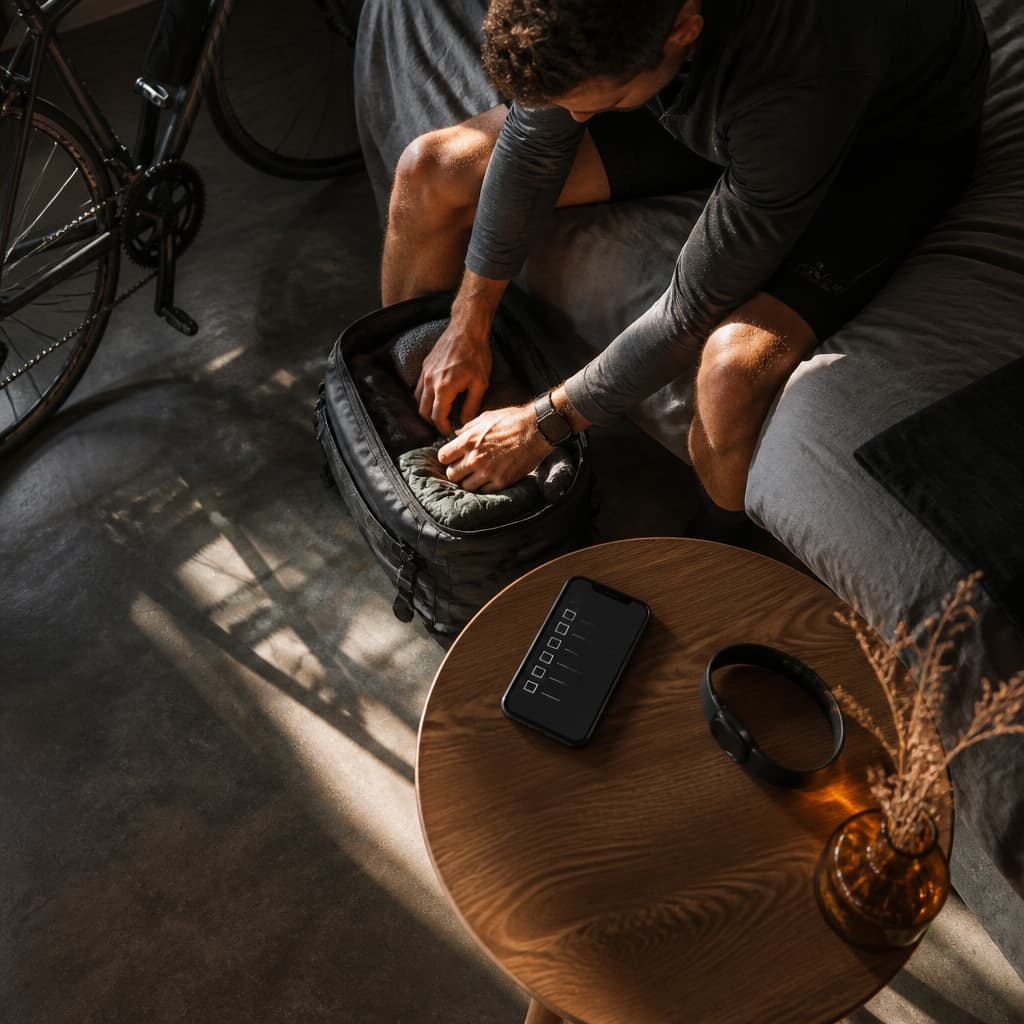
A practical way to start is to collect a clean baseline for seven days before you try to make training decisions from the number. Keep the process simple and repeatable: measure on waking, before coffee or breakfast, in the same posture, in a quiet setting, using the same device. Write down one short note about sleep, alcohol, stress, travel, illness symptoms and how recovered you feel. After a week, look for the shape of the trend rather than the size of any one reading.
One-week baseline checklist: Day 1 to Day 7 — measure at the same time each morning; use the same device and posture; stay still and quiet; record sleep quality; note alcohol the night before; note stress, travel, illness symptoms and hard training; add a simple recovery rating; compare each day with your own rolling pattern, not a fixed cut-off. If the number looks unusual and you also feel unwell, treat the symptoms as the priority.
REFERENCES
Sources
- Schmitt L, Regnard J, Millet GP. Monitoring Fatigue Status with HRV Measures in Elite Athletes: An Avenue Beyond RMSSD?. Frontiers in Physiology.View source
- Manresa-Rocamora A, Sarabia JM, Javaloyes A, Flatt AA, Moya-Ramón M. Heart Rate Variability-Guided Training for Enhancing Cardiac-Vagal Modulation, Aerobic Fitness, and Endurance Performance: A Methodological Systematic Review with Meta-Analysis. International Journal of Environmental Research and Public Health.View source
- Dobbs WC, Fedewa MV, MacDonald HV, Holmes CJ, Cicone ZS, Plews DJ, Esco MR. The Accuracy of Acquiring Heart Rate Variability from Portable Devices: A Systematic Review and Meta-Analysis.. Sports Medicine.View source
- Doherty C, Baldwin M, Keogh A, Caulfield B, Argent R. Keeping Pace with Wearables: A Living Umbrella Review of Systematic Reviews Evaluating the Accuracy of Consumer Wearable Technologies in Health Measurement.. Sports Medicine.View source
- Healthdirect Australia. Heart arrhythmias. Healthdirect Australia.View source